🐝 Intermittent Fasting – Which Method Is Right for You?
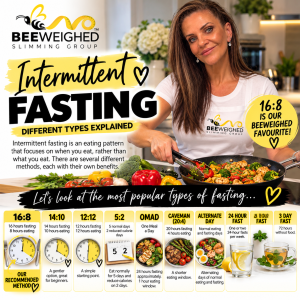
16:8, 5:2, OMAD, Caveman Fasting and even 3-Day Fasts – what’s the difference, what are the benefits, and which one works best for long-term weight loss?
At BEEWEIGHED, we believe that successful weight loss isn’t about starving yourself, following extreme diets or making your life miserable. It’s about finding a healthy, realistic way of eating that fits around YOUR lifestyle! 💛🐝
One approach we often discuss in our meetings is intermittent fasting.
You may have heard of the popular 16:8 method, but did you know there are several different types of fasting, each with its own potential benefits and challenges?
Let’s explore them and explain why, at BEEWEIGHED, 16:8 is our preferred method for members who choose to fast.
⏰ What Exactly Is Intermittent Fasting?
Intermittent fasting (IF) is an eating pattern that focuses on when you eat rather than necessarily what you eat.
Instead of eating throughout the entire day, you have a designated eating window and a period when you don’t consume calories.
During a fasting period, you can generally enjoy water, plain tea and black coffee without milk or sugar.
Research suggests intermittent fasting can help some people with:
- Weight management.
- Reducing unnecessary snacking.
- Blood sugar regulation.
- Certain markers of metabolic health.
- Developing more structured eating habits.
However, the benefits depend on the fasting method, the individual and their overall diet.
And remember, fasting isn’t magic! For weight loss, your overall calorie intake still matters, along with the quality of your food, your protein intake and your consistency.
🐝 1. The 16:8 Method – Our BEEWEIGHED Favourite!
16 HOURS FASTING • 8 HOURS EATING
This is the method we favour at BEEWEIGHED because we believe it’s one of the easiest to incorporate into everyday life.
You fast for 16 hours and enjoy your meals within an 8-hour window.
For example, you might finish your evening meal at 7 pm and have your first meal the following day at 11 am.
The great thing is that you’re asleep for much of your fasting period!
✅ Potential Benefits
- Helps reduce late-night snacking and mindless eating.
- May naturally reduce calorie intake without complicated rules.
- Gives your day a simple, consistent eating routine.
- May improve blood sugar regulation and insulin sensitivity in some people.
- Can be adapted around work, family life and social occasions.
- Allows time for balanced meals with adequate protein, fibre, fruit and vegetables.
💛 Why We Recommend It
It doesn’t require fasting for entire days or drastically restricting calories on certain days. You can still enjoy satisfying meals by adjusting your timings.
You can also start with 12:12 or 14:10 and gradually work towards 16:8 if it suits you.
It’s not compulsory, and it isn’t necessarily better than a regular healthy eating routine. But for members who enjoy having structure, it can be a fantastic tool!
🐝 2. The 5:2 Diet
5 NORMAL EATING DAYS • 2 REDUCED-CALORIE DAYS
With the 5:2 method, you eat normally for five days of the week and significantly reduce your calorie intake on two non-consecutive days.
Traditionally, reduced-calorie days involve approximately 500–600 calories, although some versions use a higher allowance.
✅ Potential Benefits
- Can create an overall weekly calorie deficit.
- Offers flexibility on the five normal eating days.
- May help some people lose weight and improve metabolic markers.
- Only requires specific calorie restrictions on two days each week.
⚠️ Things to Consider
Those two very low-calorie days can leave you hungry, tired, irritable or struggling to concentrate. Getting sufficient protein and other nutrients can also be difficult.
At BEEWEIGHED, we prefer a more consistent approach that doesn’t involve dramatically reducing food intake on particular days.
🐝 3. The 14:10 Method
14 HOURS FASTING • 10 HOURS EATING
This is a gentler version of intermittent fasting.
For example, finish eating at 7 pm and have breakfast at 9 am.
✅ Potential Benefits
- Easier for beginners than longer fasts.
- Can reduce unnecessary evening snacking.
- Allows a generous eating window.
- May help establish a regular meal routine.
- Can be a useful stepping stone towards 16:8.
For members who find 16:8 too restrictive, 14:10 may be a better long-term choice.
Consistency matters more than achieving a particular fasting number!
🐝 4. OMAD – One Meal a Day
APPROXIMATELY 23 HOURS FASTING • 1 HOUR EATING
OMAD is one of the more extreme intermittent fasting methods.
As the name suggests, you consume your daily food in one main meal.
✅ Potential Benefits
- Provides a very simple eating schedule.
- May reduce overall calorie intake.
- May lead to weight loss if it creates a calorie deficit.
- Some people enjoy not having to plan several meals.
⚠️ Things to Consider
It’s extremely difficult to get all your daily protein, fibre, vitamins and minerals into one meal. It can also cause intense hunger, headaches, fatigue and overeating.
For people who exercise regularly, maintaining muscle mass and supporting recovery may become more challenging.
At BEEWEIGHED, we don’t recommend OMAD as a routine weight-loss strategy.
We want our members to nourish their bodies, not spend most of their day feeling hungry!
🐝 5. Caveman / Warrior Fasting
OFTEN 20 HOURS FASTING • 4 HOURS EATING
Sometimes described as Warrior Fasting, this approach is inspired by the idea of eating less frequently, as our distant ancestors may have done.
The Warrior Diet typically involves a 20-hour period of fasting or very light eating, followed by a four-hour eating window.
It’s worth remembering that the Paleo or Caveman Diet is slightly different: that focuses on which foods you eat, rather than the time you eat them.
✅ Potential Benefits
- May reduce opportunities for unnecessary snacking.
- Can create a calorie deficit.
- Provides a structured eating routine.
- May appeal to people who naturally prefer eating later in the day.
⚠️ Things to Consider
There is limited evidence that a 20:4 schedule provides greater health benefits than shorter fasting methods.
It can be difficult to eat enough nutritious food in such a small window.
At BEEWEIGHED, we believe a less restrictive approach is generally more practical.
🐝 6. Alternate-Day Fasting
ALTERNATING NORMAL EATING AND FASTING DAYS
With alternate-day fasting, you eat normally one day and fast or consume a very limited number of calories the next.
Some modified versions allow around 25% of normal calorie requirements on fasting days.
✅ Potential Benefits
- Can help create a substantial weekly calorie deficit.
- Studies suggest it may support weight loss.
- May improve certain metabolic health markers.
- Some people find alternating days easier than daily restrictions.
⚠️ Things to Consider
Hunger and low energy can be challenging on fasting days. It may also interfere with exercise, family meals and social occasions.
Research hasn’t established that alternate-day fasting consistently produces better long-term weight loss than conventional calorie restriction.
🐝 7. Eat-Stop-Eat – The 24-Hour Fast
ONE OR TWO 24-HOUR FASTS PER WEEK
This method involves fasting for a complete 24-hour period, such as from dinner one evening until dinner the following evening.
✅ Potential Benefits
- May reduce overall weekly calorie intake.
- Doesn’t require daily fasting windows.
- May help with weight loss when overall energy intake decreases.
- Some people appreciate having normal meal patterns on other days.
⚠️ Things to Consider
A whole day without food can be physically and mentally demanding.
Headaches, dizziness, irritability and reduced exercise performance are possible.
We don’t believe most members need to go an entire day without eating to achieve fantastic weight-loss results.
🐝 8. The 36-Hour Fast – The Monk Fast
APPROXIMATELY 36 HOURS WITHOUT FOOD
This extended fast might involve finishing dinner on Monday evening and not eating again until Wednesday morning.
✅ Potential Physiological Effects
- Can produce a substantial short-term calorie deficit.
- May increase fat utilisation during the fasting period.
- May temporarily lower insulin levels.
- Has been explored in research into metabolic health.
⚠️ Things to Consider
Longer fasting doesn’t automatically mean better fat loss.
Some initial weight loss is water and glycogen rather than body fat.
The risk of dizziness, dehydration, low blood pressure and difficulty meeting nutritional needs increases with longer fasts.
This isn’t a method we recommend for general BEEWEIGHED weight management.
🐝 9. The 3-Day Fast – 72 Hours
72 CONSECUTIVE HOURS WITHOUT FOOD
A three-day fast is a prolonged fast during which no food is consumed for three consecutive days.
You may have seen online claims that a 72-hour fast completely resets your immune system, dramatically detoxifies your body or triggers extraordinary fat-burning benefits.
It’s important to separate scientific evidence from social media hype.
✅ Potential Physiological Effects
- The body increasingly relies on stored fat and produces more ketones.
- Insulin levels generally decrease during fasting.
- Blood glucose and other metabolic markers may change temporarily.
- Cellular processes such as autophagy may be affected, although the timing and clinical significance in humans remain uncertain.
- Weight may fall rapidly, but some of that loss is water and glycogen.
⚠️ Things to Consider
Three days without food carries significantly greater risks, including dehydration, electrolyte disturbances, fainting and problems with blood glucose.
Some people may also lose lean tissue.
There isn’t convincing evidence that routine three-day fasts offer superior sustainable weight loss compared with safer, less restrictive approaches.
At BEEWEIGHED, we do not recommend prolonged three-day fasts for weight loss. They should not be attempted without appropriate medical supervision.
🐝 10. The 12:12 Method – A Gentle Introduction
12 HOURS FASTING • 12 HOURS EATING
This is perhaps the simplest form of time-restricted eating.
For example, finish eating at 7 pm and have breakfast at 7 am.
✅ Potential Benefits
- Encourages a regular eating routine.
- Helps reduce late-night grazing.
- Allows plenty of time for nutritious meals.
- Is generally easier to maintain than longer fasting windows.
- Can help members recognise the difference between genuine hunger and eating out of habit.
Although the evidence for specific metabolic benefits from 12:12 is limited, it can be a practical starting point for someone who wants to develop healthier habits.
💛 Why BEEWEIGHED Recommends 16:8
At BEEWEIGHED, we’re all about LONG-TERM RESULTS, NOT QUICK FIXES!
We favour 16:8 for members who want to try intermittent fasting because we believe it offers a sensible balance between structure, flexibility and sustainability.
🐝 Six Reasons We Love 16:8
1. It’s realistic!
You’re asleep for much of the fasting period, so you’re not necessarily spending 16 waking hours feeling hungry.
2. It can help control snacking!
Having a clear finish time in the evening may help prevent those extra calories from biscuits, crisps, chocolate and other snacks.
3. You can still enjoy your favourite foods!
Nothing is off limits at BEEWEIGHED. It’s about balance, portion awareness and making choices that work for you.
4. It works alongside your personalised calorie allowance!
You can follow your BEEWEIGHED plan and enjoy satisfying meals within your eating window.
5. It can fit around real life!
Going out for dinner? Having a family celebration?
Adjust your eating window or take a day off fasting. One different day doesn’t undo your progress.
6. It encourages consistency!
We would rather see you following a realistic routine for months and years than struggling with an extreme fasting regime for a few days.
Importantly, research doesn’t show that 16:8 is universally superior to other balanced, calorie-controlled approaches for weight loss.
Its biggest advantage for many people is simply that it can make healthy eating easier to manage.
🍽️ What Could a BEEWEIGHED 16:8 Day Look Like?
🥣 11 AM – BREAKFAST
Greek yoghurt, berries and oats, or eggs on wholemeal toast.
🥗 2 PM – LUNCH
Chicken salad wrap, vegetable soup with a protein source, or a jacket potato with tuna.
🍽️ 6:30 PM – EVENING MEAL
Salmon, potatoes and plenty of vegetables, or your favourite BEEWEIGHED recipe.
🌙 7 PM – FASTING BEGINS
Water, plain tea or black coffee until 11 am the following morning.
You can include snacks during your eating window if they fit your nutritional needs and calorie allowance.
Don’t forget your water, fruit, vegetables and plenty of protein, particularly if you’re exercising and want to maintain your muscle mass.
⚠️ Is Intermittent Fasting Suitable for Everyone?
No, and that’s really important!
Fasting is not recommended for:
- Children and teenagers.
- Anyone who is pregnant or breastfeeding.
- People with a current or previous eating disorder.
People with diabetes, particularly those taking medication that can cause low blood sugar, and anyone with a significant medical condition or medication requiring food should seek medical advice before fasting.
If fasting leaves you dizzy, weak, excessively hungry or feeling unwell, it isn’t something to push through.
Fasting is always optional at BEEWEIGHED.
🐝 Our Final BEEWEIGHED Message
Whether you choose 16:8, 14:10, 12:12 or no fasting whatsoever, remember this:
THE BEST WEIGHT-LOSS PLAN IS THE ONE YOU CAN MAINTAIN! 💛
You don’t have to starve yourself, miss out on family meals or follow extreme fasting regimes to lose weight.
At BEEWEIGHED, we recommend 16:8 as an optional approach because it’s simple, flexible and, for many people, sustainable.
But if you love your early breakfast, need regular meals or simply don’t enjoy fasting, that’s absolutely fine too!
We believe in personalised calorie allowances, healthy habits, plenty of support and enjoying the foods you love.
Because losing weight is one thing…
KEEPING IT OFF FOR GOOD IS WHAT REALLY MATTERS! 💛🐝
No judgement. No foods off limits. Just real, sustainable weight loss.
Lots of love,
Lynda & the BEEWEIGHED Team 🐝💛🥰