
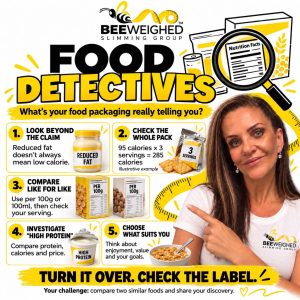
BEEWEIGHED Food Detectives 🔍🐝
What’s your food packaging really telling you?
You’re in the supermarket choosing between two snacks. One says “high protein” in big letters and costs a little more. The other is your usual. Which goes in the trolley?
Before you decide, turn both packets over.
This week at BEEWEIGHED, we’re becoming Food Detectives. We’ll look at what those front-of-pack claims actually tell us, how to compare two products fairly and how to work out what’s in the portion we’ll actually eat.
What does “reduced fat” tell you?
A reduced-fat product contains at least 30% less fat than comparable products. How much fat it still contains depends on what it’s being compared with, and its calories may be closer to the regular version than you’d expect.
If calories are what you’re checking, compare the calories per 100 g on both packs. Then think about which one you’d actually enjoy and how much you’d usually eat.
Is that one serving or the whole packet?
Imagine a snack bag that says “Only 95 calories per serving”. Turn it over and you see there are three servings in the bag. If you eat the whole bag, that’s 285 calories.
You might still fancy the whole bag. Knowing what the label means helps you log it accurately if you’re tracking. The same check comes in handy with bottles, tubs and packets you’d usually finish in one go.
Try this cereal challenge
Which cereal looks lower in calories? These two labels are made up, but the difference in suggested serving sizes is something you’ll see in the supermarket.
What you’re comparing | Cereal A | Cereal B |
Calories per 100 g | 380 | 420 |
Suggested serving | 45 g | 30 g |
Calories per suggested serving | 171 | 126 |
Calories in the same 45 g portion | 171 | 189 |
Cereal B looks lower in calories when you compare the suggested servings. Give both cereals the same 45 g portion, though, and Cereal A comes out lower.
Start with per 100 g for food or per 100 ml for drinks so you’re comparing like for like. Then check what your own serving would provide. You might also look at fibre, consider what you’ll have with it and think about which breakfast you’ll look forward to.
Is “high protein” worth paying extra for?
If you’re trying to get more protein, compare the amount you’d actually eat with a snack or yoghurt you already buy. How much protein would each give you? How do the calories and price compare?
You might find the higher-protein option is worth it for you. You might find your usual yoghurt gives you what you want for less.
What does a red traffic light mean?
A red traffic light means the food is high in the nutrient it flags. That’s one piece of information you can use alongside how much you eat, how often you have it and what else you enjoy across the week. There’s room for foods you love without guilt. 💛
Your five-question supermarket check
- What exactly is the claim on the front telling me?
- Are the calories for one serving or the whole pack?
- How does it compare with a similar product per 100 g or 100 ml?
- What will the amount I actually eat give me?
- Do I enjoy it, and is it worth the price to me?
This week’s BEEWEIGHED challenge 🐝
Pick one product you buy partly because of a claim on the pack. Turn it over and compare it with a similar product. You might find a cheaper option, spot a serving size that surprises you or decide your usual choice suits you just fine.
Bring your discovery to your next BEEWEIGHED meeting. I’d love to hear what you found and whether it changed what went in your trolley.
Lynda XX